Most of that is preventable. For a solo clinic or a small wound care or specialty office, private practice healthcare copywriting follows a predictable path, and knowing it ahead of time is the simplest way to end up with pages that still sound like you.
What Healthcare Copywriting Covers For A Private Practice
Copywriting is writing that asks someone to act. For your practice, that usually means calling or booking online. The work covers your home page and service pages, local SEO articles, and the emails patients receive after they book.
Writing for medical journals is a different job entirely. This is plain-language writing for a worried person scrolling at 11 p.m., and it succeeds when that person calls you the next morning.
TL;DR Quick Answers
Private Practice Healthcare Copywriting
Private practice healthcare copywriting is marketing writing for independent and small healthcare practices: the website, local SEO content, and patient emails that bring in the right patients while keeping the owner’s own voice.
Who it’s for: solo and small practices, from family medicine and direct primary care to wound care, physical therapy, mental health, and specialty clinics.
What sets it apart: one writer who reads your reviews, studies the practices outranking you, and writes in plain language a worried patient can follow on the first read.
How a project runs: eight stages from kickoff call to measuring results, with you approving every clinical claim.
How long it takes: 2 to 4 weeks for most practice websites, about a week per page or blog post.
What it costs: often a few hundred dollars per page, with a written quote before any work starts.
Top 5 Takeaways
Expect eight stages. Kickoff, research, outline, drafting, compliance review, revisions, delivery, and measuring, in roughly that order.
Protect two meetings. Your input changes the outcome most at the kickoff call and the compliance review.
Plan on 2 to 4 weeks for a website. A single page or blog post usually takes about a week.
Keep clinical sign-off in-house. Your writer flags claims, and you or your counsel approve them.
Choose plain over impressive. Patients book with the practice they understand.
The Healthcare Copywriting Process, Step By Step
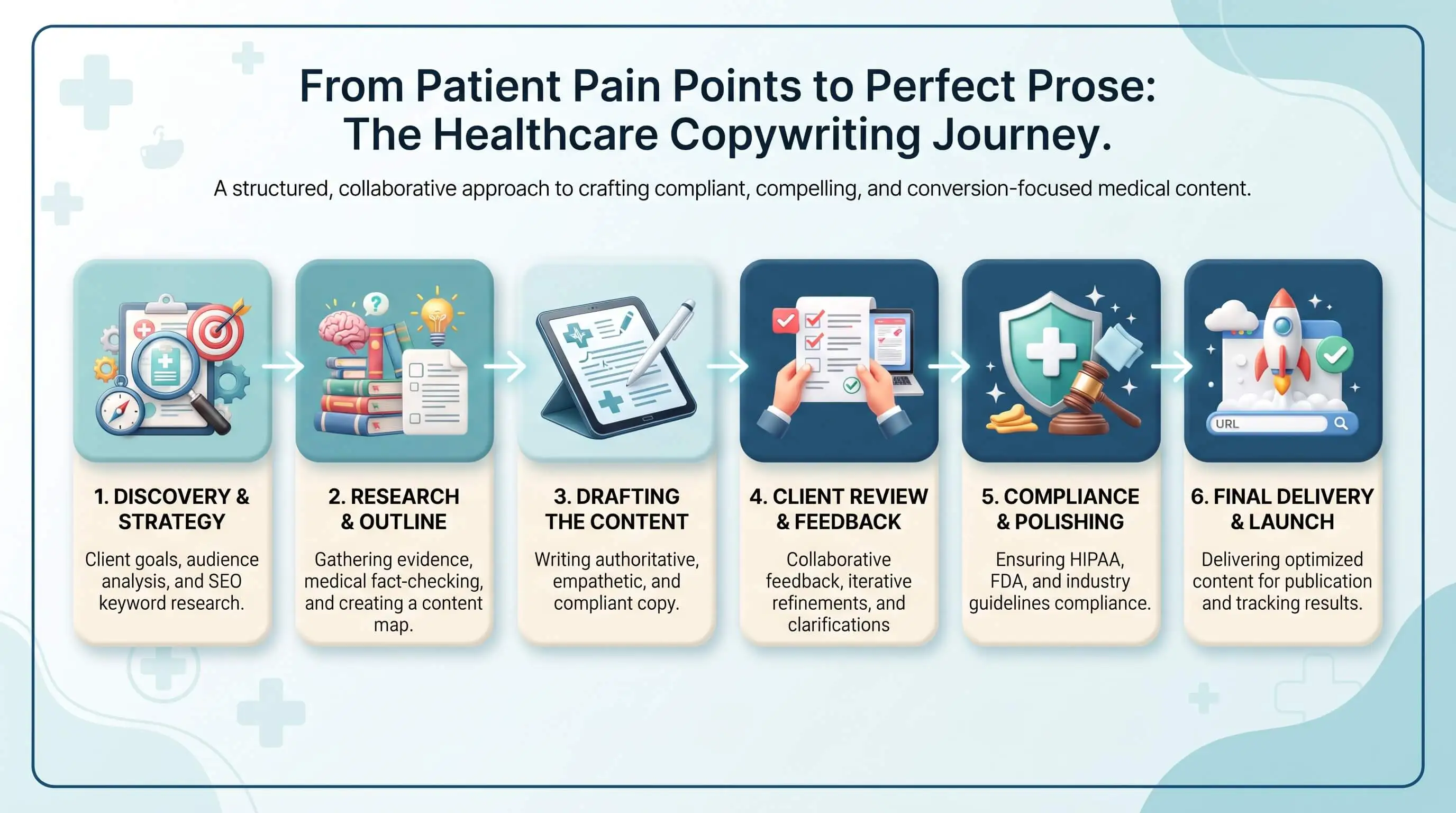
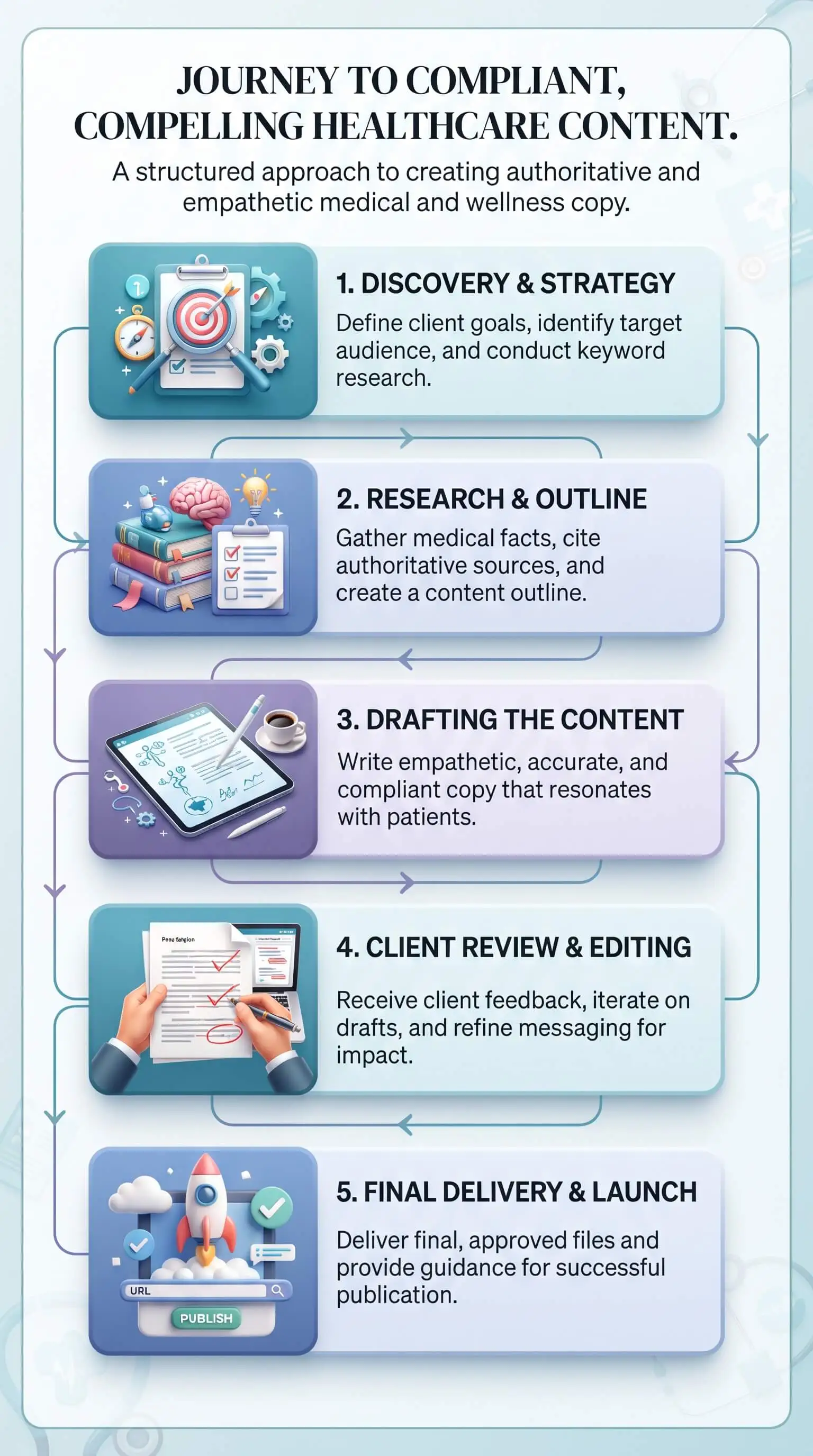
Writers name the stages differently, but most projects run through these eight in the same order.
Kickoff call. You and your writer talk through your goals, the patients you want more of, and the services worth growing. Expect questions about how you sound in the exam room, too. It works a lot like an intake interview, with your practice as the patient.
Research. Your writer reads your Google reviews and studies the practices that outrank you. They’ll also ask your front desk which questions come up every week, and those questions often turn into your headings.
Outline and approval. Before anyone drafts a paragraph, you see a page plan with the main messages and target keywords. Push back now. A change at this stage takes minutes, while the same change after drafting can eat a full revision round.
Drafting. Your writer keeps sentences short and puts benefits ahead of features. Every page ends with one clear next step for the patient.
Clinical and compliance review. Your writer marks every health claim and patient story, and you or your attorney approve those lines. Clinical accuracy stays your call.
Revisions. Tell the writer what feels off and why. “This doesn’t sound like me” gives them something to fix, while “make it pop” leaves them guessing.
Delivery. You receive final copy along with meta titles, meta descriptions, and image alt text, ready for whoever updates your site.
Measuring and refreshing. Track calls and booking requests alongside your local search rankings. Then revisit your strongest pages about twice a year.
Your time matters most at kickoff and at compliance review. A good writer can carry nearly everything in between, including applying medical copywriting tips to keep the content clear, accurate, and patient-friendly.
How Long Does A Healthcare Copywriting Project Take?
Full practice website: 2 to 4 weeks from kickoff to final draft
Single service page: about a week
Blog post or patient education article: about a week
Email welcome sequence: 1 to 2 weeks
Late projects almost always trace back to a draft sitting in someone’s inbox, or a website login nobody can find. Block an hour on your calendar for each review round. You’ll likely finish on schedule.
What To Have Ready Before Kickoff
Your services, ranked by which ones you most want to grow
The ten questions patients ask most often
Links to a few competitors you respect or worry about
Any existing copy, brand colors, or past marketing you liked
The name of the person who approves clinical claims
Why Plain Copy Earns Patient Trust
Patients read before they call. Picture a wound care clinic that explains, in everyday words, what purulent drainage means and when it needs attention. By the first appointment, that clinic has already answered the worry, and the patient walks in calmer and halfway to trusting the team.
Clever lines rarely book appointments, but clear answers in your own voice make calling you feel like the obvious next step.
“After five-plus years writing for independent clinics, I can tell you projects almost never go sideways during the writing. They stall at kickoff, when nobody tells me which patients the practice wants, or at review, when a draft sits unopened for three weeks. So I ask a lot of questions up front. I also read every review a practice has before I write a word, because patients describe you better than any brochure can. When I rewrote one occupational-health clinic’s pages that way, they went on to rank #1 for 33 of the searches their patients use. It isn’t a glamorous process, but it holds up.”
Essential Resources
Seven references worth keeping open during your project. Start with whichever one matches the step you’re on.
1. Know When Patient Information Counts As Marketing
HHS spells out when HIPAA treats a message as marketing and when you need a patient’s written authorization first. Read it before anyone plans an email built on your patient list.
Source: HHS: HIPAA Privacy Rule and Marketing
2. Keep Your Health Claims Defensible
The FTC expects health claims to be truthful, not misleading, and supported by competent and reliable scientific evidence. That’s why a careful writer flags claims for you instead of quietly softening them.
Source: FTC Health Products Compliance Guidance
3. Check Your Draft Against The CDC Checklist
The CDC’s plain language checklist is short enough to keep beside your draft. It asks you to lead with the most important message, write in an active voice, aim for about 20 words per sentence, and talk to the reader as “you.”
Source: CDC: Plain Language Materials and Resources
4. Write For Patients With Limited Health Literacy
NIH’s Clear & Simple guide walks through defining your audience, researching it, testing drafts with members of that audience, and revising. That sequence lines up closely with the research and revision steps above.
Source: NIH: Clear & Simple
5. See Your Site The Way Patients Judge It
Before patients trust a health website, MedlinePlus suggests they ask who runs it, who pays for it, where its information comes from, and how current it is. Your copy should answer all four without anyone digging.
Source: MedlinePlus: Evaluating Health Information
6. Learn What Google Rewards
Google’s guidance on helpful, people-first content asks whether a page shows first-hand expertise and makes its authorship clear. Good patients copy answers yes to both without straining.
Source: Google Search Central: Creating Helpful, Reliable, People-First Content
7. Put Your Copy Inside A Marketing Plan
The SBA’s marketing and sales section covers target markets, goals, budgets, and measuring return. Copy does its best work as one piece of a plan like that.
Source: SBA: Manage Your Business, Marketing and Sales
Supporting Statistics
Three numbers worth knowing before your kickoff call, each from a U.S. government or national academy source.
1. More Than Half Of Adults Research Health Online
Between July and December 2022, 58.5% of U.S. adults went online for health or medical information, and 41.5% used the internet to contact a doctor or doctor’s office. For plenty of new patients, your website is the first conversation they have with you.
Source: CDC/NCHS Data Brief No. 482: Health Information Technology Use Among Adults
2. Nearly Half Of Adults Struggle With Health Information
About 90 million American adults have trouble understanding and using health information. Plain-language drafting exists for exactly this reader.
Source: National Academies: 90 Million Americans Are Burdened With Inadequate Health Literacy
3. You’re One Of Roughly 975,000
The 2022 Economic Census counted about 975,400 health care and social assistance establishments in the U.S. Copy that sounds like everyone else disappears into that number.
Source: U.S. Census Bureau: 2022 Economic Census First Look
With 58.5% of U.S. adults researching health information online, approximately 90 million struggling to understand medical content, and roughly 975,400 healthcare and social assistance establishments nationwide, private practice healthcare copywriting plays an important role in creating clear, patient-friendly website content that builds trust and helps practices stand out.
Final Thoughts And Opinion
Here’s my honest take, after watching a lot of these projects play out. A writer’s process matters more than their portfolio, because a gifted writer working from a sloppy process will still hand you pages that miss your voice or skip a compliance check.
A few patterns keep showing up:
Owners who show up for kickoff get better first drafts. Thirty focused minutes there usually saves a whole round of revisions.
Plain copy books have more appointments than polished copy. Patients choose the practice they understand.
Projects finish on time when one person owns a sign-off. Without that person, drafts sit in inboxes.
Practices that refresh their best pages keep ranking. For most, twice a year is plenty.
My take, plainly: when you weigh private practice healthcare copywriting and medical healthcare copywriting services, judge the writer by how clearly they explain their process to you. A writer who can walk you through the work in plain words can usually do the same for your patients.
Frequently Asked Questions
Q: How Long Does A Healthcare Copywriting Project Take?
A: Most full practice websites take 2 to 4 weeks from kickoff to final draft. A single service page or blog post takes about a week, and slow sign-off is the usual reason a project runs long.
Q: What Should I Give A Healthcare Copywriter Before We Start?
A: Bring a ranked list of your services, the questions patients ask most, a few competitor websites, any copy you already have, and the name of whoever approves clinical claims. That’s plenty for a productive kickoff call.
Q: How Many Revisions Are Usually Included?
A: It depends on the writer, so ask before you sign. Some writers include a set number of rounds. Riley James Copy offers free client-requested edits until you’re satisfied.
Q: Who Checks Healthcare Copy For HIPAA And Medical Accuracy?
A: You do, with your writer’s help. A good copywriter flags health claims and patient stories and writes within HIPAA’s marketing rules, and the practice or its counsel makes the final call.
Q: How Much Does Private Practice Healthcare Copywriting Cost?
A: Pricing depends on scope and on the writer. Single pages often run a few hundred dollars and full website builds cost more, so get a written quote before any work begins.
Q: Can A Copywriter Cover Clinical Topics Like Wound Care Without A Medical Degree?
A: Yes, for patient-facing marketing and education. The writer researches, writes in plain language, and flags anything clinical for your review. Journal articles and clinical documentation call for a medical writer instead.
Let’s Map Out Your First Page
Pick one page, jot down the questions your patients ask most, and talk it through with a writer who’ll explain each stage in plain words. To work through it with Riley, book a free 15-minute call. You’ll leave with a plan for your first page.
Wound care runs on catching small changes early, which is why patients do better when they know the phases of wound healing before anything looks wrong. A copywriting project works the same way. Settle your voice, your priorities, and your sign-off process before the first draft, and the pages that come back will be accurate enough to sit next to the care you provide.